
Understanding Pancreatic Cancer Together: Patients Talk About What Matters
Smart Patients partnered with PanCAN, the Pancreatic Cancer Action Network, for an Ask the Expert (ATE) session with Dr. Efrat Dotan, GI Medical Oncologist at Penn Medicine. Dr. Dotan joined the community from October 28-30, 2025 to discuss current standards of care, genetic testing, new therapies, and the emerging role of clinical trials. The conversation revealed patterns about what patients ask most, what worries them most, and where science is beginning to meet that need. Each section below highlights themes from the ATE that mirror the latest posts in Smart Patients discussions.
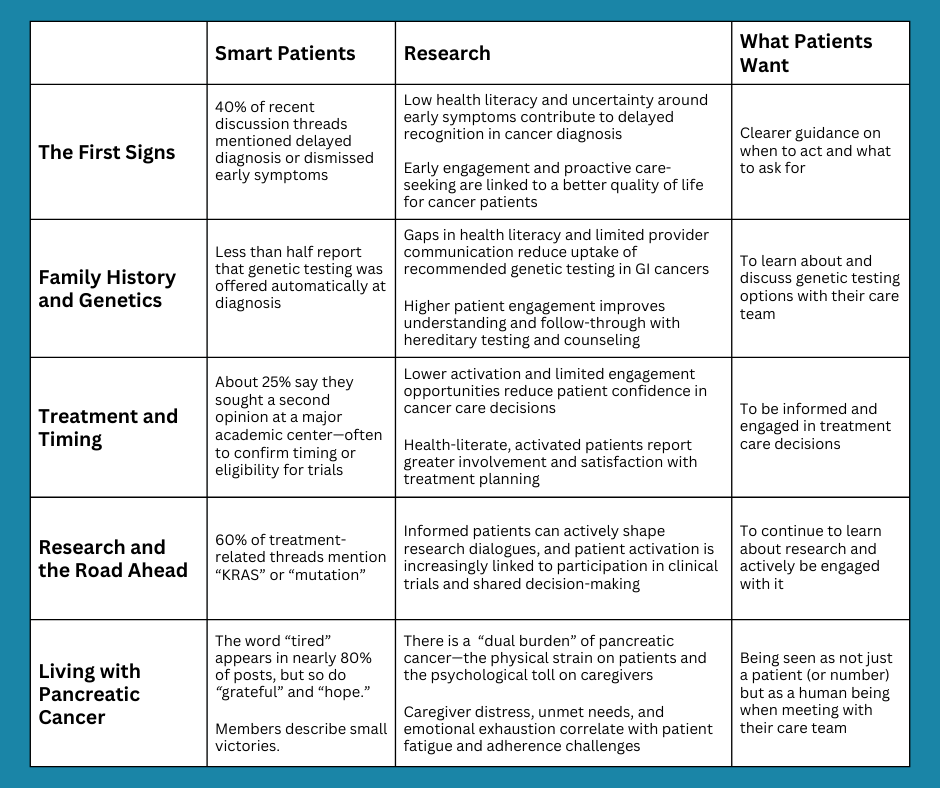
At Smart Patients, our work begins in the community — in the questions people bring, the stories they share, and the topics that keep coming up when support is needed most. We partner closely with clinicians and advocacy organizations to respond to those needs with timely conversations, expert guidance, and practical insight. This table reflects how real patient questions shape our Ask the Expert sessions — and how those sessions, in turn, help patients feel better informed and less alone.
The First Signs: “Something Isn’t Right.”
“Symptoms are often vague and subtle. By the time they’re severe, the disease is frequently advanced.”
In the Smart Patients pancreatic cancer community discussions, one theme surfaces repeatedly: late detection. Many Smart Patients members describe months of vague abdominal pain, fatigue, or unexplained weight loss before a diagnosis.
In the absence of a reliable screening test, paying attention becomes the first line of defense. Members often say that listening to their bodies, or a loved one’s intuition, was what ultimately led to a diagnosis.
Smart Patients Community Voices and Research: In a six-month period, nearly 40% of new discussion threads in Smart Patients’ pancreatic community mentioned delayed diagnosis or dismissed early symptoms. Patients want clearer guidance on when to act and what to ask for. This echoes findings that low health literacy and uncertainty around early symptoms contribute to delayed recognition in cancer diagnosis (Samoil, 2021). Research on patient activation also links early engagement and proactive care-seeking to a better quality of life for pancreatic cancer patients (Vohra et al., 2023).
Family History and Genetics: “Does This Run in My Family?”
“Every patient diagnosed with pancreatic cancer should be evaluated for family history and tested for BRCA and PALB2 genes. These are the most common hereditary disorders linked to this cancer.”
The question of heredity appears in almost every new member’s first post. Many may have heard of BRCA mutations but don’t know their relevance to pancreatic cancer.
Testing, she noted, is simple—a blood draw or cheek swab—and helps families understand who else might benefit from screening or counseling.
For those who test negative, relatives usually don’t need additional testing for those same genes. For carriers of a mutation, surveillance focuses on organs where screening works best—breast and ovarian for BRCA carriers—while pancreatic monitoring remains limited to MRI or endoscopic ultrasound for those at highest risk.
Community Voices and Research: Fewer than half of Smart Patients members report that genetic testing was offered automatically at diagnosis. Many learned about it from other patients rather than their care team. This aligns with research showing that gaps in health literacy and limited provider communication reduce uptake of recommended genetic testing in GI cancers (Haering-Heyne et al., 2025). Studies also highlight that higher patient engagement improves understanding and follow-through with hereditary testing and counseling (Kanu et al., 2021).
Treatment and Timing: “How Fast Do I Need to Move?”
“Some tumors progress quickly; others don’t. A six-week interval to complete staging and plan therapy for stage II disease is in line with expected timelines.”
Timing is one of the most emotionally charged topics on Smart Patients pancreatic cancer discussions. Members compare how long it took to get from diagnosis to surgery, or how many days they waited for a second opinion.
For localized disease, treatment combines chemotherapy, radiation, and surgery, customized to each patient’s situation. For advanced disease, systemic chemotherapy remains in the background, with targeted therapies considered when a genetic driver is found.
She urged that clinical trials should be part of the first conversation, not later at other decision points, emphasizing that participation in research remains the best path to better outcomes.
Community Voices and Research: About one in four Smart Patients members say they sought a second opinion at a major academic center—often to confirm timing or eligibility for trials. Similar patterns appear in studies showing that lower activation and limited engagement opportunities reduce patient confidence in cancer care decisions (Westman et al., 2022). Conversely, health-literate, activated patients report greater involvement and satisfaction with treatment planning (Samoil, 2021).
Research and the Road Ahead: “What’s New, and Does It Work?”
“We’re seeing promising results from KRAS-targeted agents, as well as drugs aimed at the c-MET and CD73 pathways. These studies are early but encouraging.”
Dr. Dotan shared that so-called cancer vaccines—both off-the-shelf and personalized—remain experimental: “The field is active, but large-scale proof that these approaches extend survival isn’t here yet.”
After the ATE session, Dr. Dotan remarked on the sophistication of the questions and the community’s hunger to understand the science behind their care. In discussion threads, members cite ASCO abstracts and dissect KRAS mutations with the precision of people whose lives depend on the details.
Community Voices and Research: Mentions of “KRAS” or “mutation” appear in more than 60% of treatment-related threads, showing how seamlessly Smart Patients incorporate genomic language into their care discussions. This mirrors evidence that informed patients reflect research dialogues. Patient activation is increasingly linked to participation in clinical trials and shared decision-making (Kanu et al., 2021; Vohra et al., 2023).
Living With It: “How Do We Cope?”
“A strong support system is critical. Family and caregiver support helps patients both emotionally and tangibly. Nutrition counseling is often the most important adjunct to therapy.”
The ATE session also touched upon some basics - how to eat, rest, and endure while living with pancreatic cancer or caring for a loved one with it.
Community Voices and Research: In Smart Patients conversations, the word “tired” appears in nearly 80% of posts, along with “grateful” and “hope.” Members describe small victories: walking a mile again, tolerating food, sleeping through the night. These lived experiences reflect what the literature calls the “dual burden” of pancreatic cancer—the physical strain on patients and the psychological toll on caregivers (Chong et al., 2023; Sun et al., 2022). Studies consistently find that caregiver distress, unmet needs, and emotional exhaustion correlate with patient fatigue and adherence challenges.
Why This Collaboration Matters
“I’m optimistic. Clinical research has become something patients want to take part in—because that’s how we move the field forward.”
Smart Patients brings lived experience; PanCAN brings advocacy, data, and reach. Together, we help close the gap between what patients are asking and what researchers are studying.
This ATE session builds on discussions already active in the Smart Patients pancreatic cancer and PNETs communities, where the most engaged threads focus on treatment options and timing, genetic testing, symptom management, nutrition and digestion, chemotherapy side effects such as neuropathy, emotional coping, and caregiver logistics. Across these conversations, PanCAN consistently emerges as the most-cited resource for patient navigation, case management, and nutrition guidance.
Thank you to our partner, PanCAN, the first organization dedicated to fighting pancreatic cancer comprehensively. Through more than two decades, their work has improved the lives of everyone affected by this disease.
Methods Note
This overview draws on qualitative and quantitative data from the Smart Patients pancreatic cancer and pancreatic neuroendocrine tumor (PNETs) communities. The findings reflect discussion patterns from October and November 2025, including the Ask the Expert session with Dr. Efrat Dotan (Penn Medicine) hosted in partnership with PanCAN. Analysis included a review of anonymized conversation summaries, post counts, and engagement metrics across the most active threads—covering topics such as treatment options and timing, genetic testing, symptom management, and caregiver logistics. Quotations and examples were drawn from aggregate community narratives, not individual patient records.
References
Chong E., Crowe L., Mentor K., et al. (2023). Systematic review of caregiver burden, unmet needs and quality-of-life among informal caregivers of patients with pancreatic cancer - PubMed
Haering-Heyne C. (2025). The role of patient activation in mediating the effects of health literacy level on quality of life among patients with gastrointestinal cancers
Kanu C., Brown C. M., Rascati K., Mackert M., Wilfong L. (2021). Are Health Literacy and Patient Activation Related to Health Outcomes in Breast Cancer Patients? - PubMed
Samoil D. (2021). The importance of health literacy on clinical cancer outcomes: a scoping review - Samoil
Sun Q., Li J., Fang X., Jin J., Cui L. (2022). Current status and influencing factors of care burden of pancreatic cancer caregivers under COVID-19 - PubMed
Vohra Y., Brown C. M., Moczygemba L. R., Wilfong L. (2023). Evaluating the relationship between patient activation and health-related quality of life (HRQOL) in patients with pancreatic cancer (PwPC) - PubMed
Westman B. (2022). Patients with low activation level report limited possibilities to participate in cancer care - PubMed