
Joyce Graff's 50-Year Fight Against VHL
When Joyce Graff's husband lost his sight, she didn't know she was beginning a fight that would span five decades, two generations, and help thousands of families worldwide.
When Joyce brought the man she loved home to meet her grandparents in the early 1960s, they noticed something she hadn’t.
“What is the matter with his eye?” one of them asked.
Joyce thought they were asking about how Frank had one blue and one gray eye (a trait she found striking and elegant). But her grandparents had noticed something else entirely: that Frank was already losing his sight.
This knowledge didn’t deter Joyce and Frank’s love for each other. In fact, it accelerated their decision to elope and spend their lives together. They lived each day to the fullest knowing Frank’s future might be uncertain.
Frank had Von Hippel-Lindau disease, or VHL. The condition is different in every patient, even within the same family. It’s impossible to predict exactly how and when the disease will present for each person, so it is extremely important to check regularly for possible VHL manifestations throughout a person’s lifetime. Most VHL tumors are benign; but as they grow in size, these tumors and the associated cysts cause increased pressure on the structure around them. This pressure can create symptoms including severe pain.
Frank learned this himself soon enough. Within a year after he and Joyce wed, Frank became violently ill. He was vomiting, unable to eat. He was in college in Ithaca, NY and the campus medical center told him a flu was going around. Joyce was not satisfied. She knew his history. She called the one person she trusted to take him seriously—Frank’s ophthalmologist.
“Here’s what you’re going to do,” he told her. “Pack a bag. Drive to Columbia Presbyterian. I’ll meet you there.”
They listened and acted. Once they arrived, Frank was admitted immediately. Surgeons found a cyst the size of a large potato pressing against his brain. He almost died.
Joyce stepped into her role as a caregiver that night without ceremony or instruction. There was no language for what she was becoming, only the feeling of urgency. Over the years that followed, Frank would undergo five brain surgeries and another five on his spinal cord. He lost sight in his second eye and became completely blind. Later, after spinal surgery, he was partially paralyzed.
Joyce’s role as a caregiver continued to expand. She learned and improvised. Frank’s setbacks didn’t keep him from pursuing his academic career, and Joyce was there to help him. She read his textbooks aloud so he could finish his Ph.D. She set up a “cockpit” of five tape recorders so Frank could listen to books and lectures, then orally dictate his thoughts onto another.
By the mid-1960s, doctors began to understand that Frank’s condition affected more than the brain and eyes. Tumors were found in both of his kidneys. The only treatment was surgery. Given Frank’s physical state, his neurologist and neurosurgeon advised against operating. One urologic surgeon disagreed. He believed the tumors could be removed. Frank wanted to fight to live.
Two years later, Frank died at 35—the same age his father had died.
The Story Continues
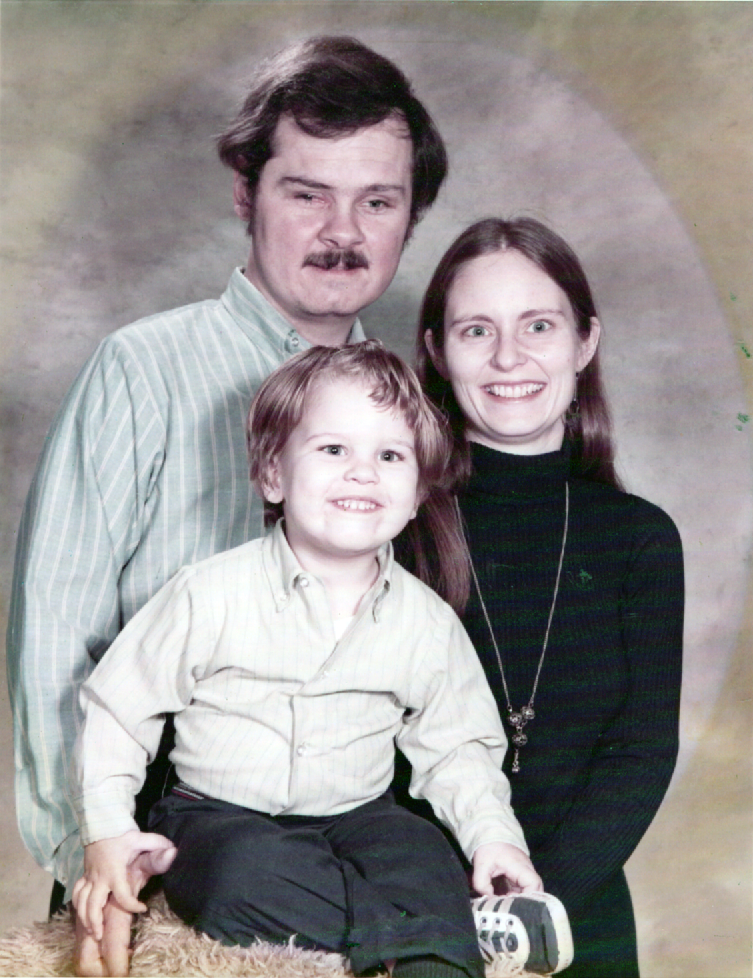
The Graff’s 1977
Joyce and Frank had a son. They understood the risk, considered adopting, but ultimately decided to have one child and hoped he would inherit more from Joyce than Frank. At the time of Frank’s diagnosis, the condition he had was considered the rarest of the rare.
There was no genetic testing then. Joyce took her son faithfully to the ophthalmologist, watching for the faint capillary changes in the retina that could signal the disease. Three times, she was told he was in the clear.
When her son was fourteen, he wanted contact lenses. Their ophthalmologist was nearing retirement and referred him to a colleague. Joyce’s son insisted on going alone. Joyce insisted on including the family history of VHL in the paperwork. The new doctor recommended her son to a retinal specialist.
“My heart went through the floor,” Joyce said.
The diagnosis came with something she had not expected: hope. Yes, her son had the same condition and would need treatment, but medicine had advanced. There were more options for her son than for Frank. They knew by then to look at the kidneys so they scheduled an ultrasound. A week later, a resident called Joyce at work and asked her to come in for an appointment. Joyce begged him to tell her what they had found. She did not think she could bear the waiting.
They had found tumors on both kidneys.
Joyce went to her boss and said, “I need to go play patient advocate. I am not sure how long it will take.” Her boss told her to take all the time she needed and to stay in touch.
From Caregiver to Medical Researcher
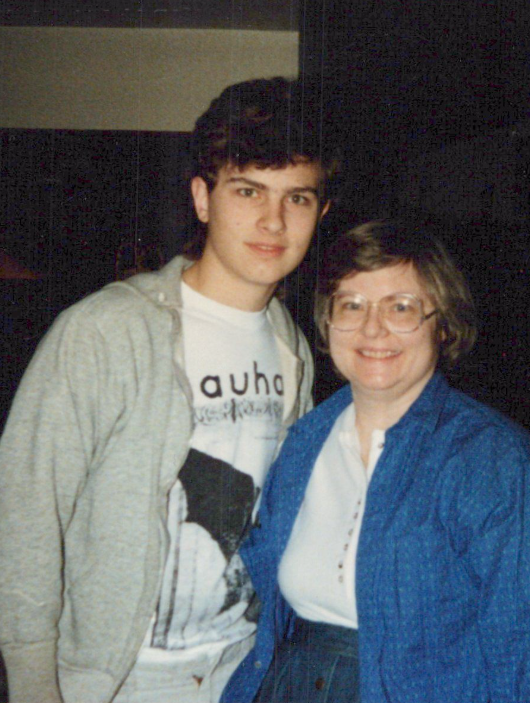
Joyce and her son, 1992
That moment marked Joyce’s second time as a caregiver. Driven to learn anything and everything she could to help her son, she became a dedicated VHL medical student with a sharp sense of purpose. She read everything she could find at Harvard’s medical library. At the time, there were fewer than twenty medical articles about VHL published over the past century. Joyce read them all, even struggling with the ones in German. She called researchers whose names appeared at the bottom of journal articles. She learned that doctors were beginning to recommend removing only part of the kidney, not the whole organ. She shared what she learned.
“I learned by bumping into walls,” she would later say.
She also realized that what she was doing in the library was what a doctor would need to do to learn more about VHL. This is when her next passion developed. She was determined to share knowledge about VHL with those who needed it.. She began to tear down the walls.
From Medical Researcher to Patient Advocate
For two years, she hesitated to reach out to other families. She was afraid their stories would be too sad. When she finally did, she found something else: collective intelligence.
With two other mothers—each widowed, each raising children at risk—Joyce helped found what would become the VHL Alliance. None of them had much time or money, but all of them had reason to spend whatever effort they could to “bring heart, soul and science to the fight.” They believed shared experience might ease the path for others who suddenly discovered they were on it. They made a pact: each would work when she could. They would bring families together to share experiences so their collective wisdom could help doctors get closer to answers.
One of their first initiatives was to organize a patient meeting in Kansas City - strategically located in the heart of the USA and near Debra Collins, M.S., one of the few genetic counselors publishing on VHL. To build awareness, they had sent letters to every doctor in the world who had worked on the disease. There were risks then in admitting to a genetic condition, such as losing insurance coverage or a job. They had second thoughts when only 30 people registered—but then 125 people showed up, including 2 from Australia.
The doctors participating were stunned by the detailed questions. When one researcher left, he said that he was so inspired he was heading straight back to his lab.
Joyce remembers a line from the film Lorenzo's Oil, when one parent says to another: "Have you ever thought that we're doing this to save someone else's child?"
That stuck with them. Turns out they were right.
Over the next twenty-five years, thousands of families would pass through the organization Joyce helped build, sharing medical records, experiences, hard-won lessons. Treatments improved; diagnostic pathways became clearer. The VHL Handbook is now in its 7th edition and available in multiple languages. A drug was developed five years ago. According to Joyce, it’s “not perfect,” but it is effective and will get better. Finally there is an alternative to surgery.
Present Day Pioneers
Today, Joyce is still a caregiver. She and her son continue to travel to the National Institutes of Health to support VHL research. Her son is now in his fifties. She is so proud of him for all that he’s enduring, and for contributing to the very progress that has made his life longer and fuller than his father’s could be.
A decade ago, Joyce retired from the organization she helped build; but she hasn’t stopped working. She continues to advise families with complex medical conditions. She also runs a patient platform that deals with many diseases and topics. (https://powerfulpatient.org/)
“Forward is the right direction,” she says.
For Joyce Graff, caregiving has been about learning, building community, and making the road clearer for those who would have to walk it next. She and her son are true pioneers.
Frank would be proud.
February 20th is National Caregivers Day—a time to recognize caregivers and their contributions to families and healthcare systems.
February 28th is Rare Disease Day - a time to raise awareness for 300 million people worldwide living with rare diseases.
On both of these days, we honor people like Joyce—caregivers who become advocates, advocates who become architects of change.
To hear from Joyce directly: https://www.youtube.com/watch?v=put9DoSKcUI